Kottu Roti and Murtabak at the 2012 Cabbagetown Festival, Toronto, Ontario, Canada

The Cabbagetown Festival takes place annually on the weekend after Labour Day on Parliament Street in Toronto, Ontario, Canada. It features food, arts and crafts, and a film festival. I always look forward to this festival to enjoy street food that it usually offers. There are many food options and every stand you pass by is more seductive than the last. Finding something authentic is a safe bet because there is a sizeable population from a variety of cultures in the Cabbagetown area.

Needless to say, I went to the Festival with an empty stomach so my taste buds were yearning for something exotic. Instead of writing about every little thing I ate, here are some of my favorite eats. Avoiding all of the vendors with long lines (I like instant gratification), I waltzed my way towards a vendor making awfully huge amount of chopping sound. Not surprisingly it was Kottu Roti. You’ll know when Kottu Roti is being made because of the noise – the ingredients are usually simultaneously chopped on a hot griddle using a large pair of meat cleavers, producing a noisy sound.
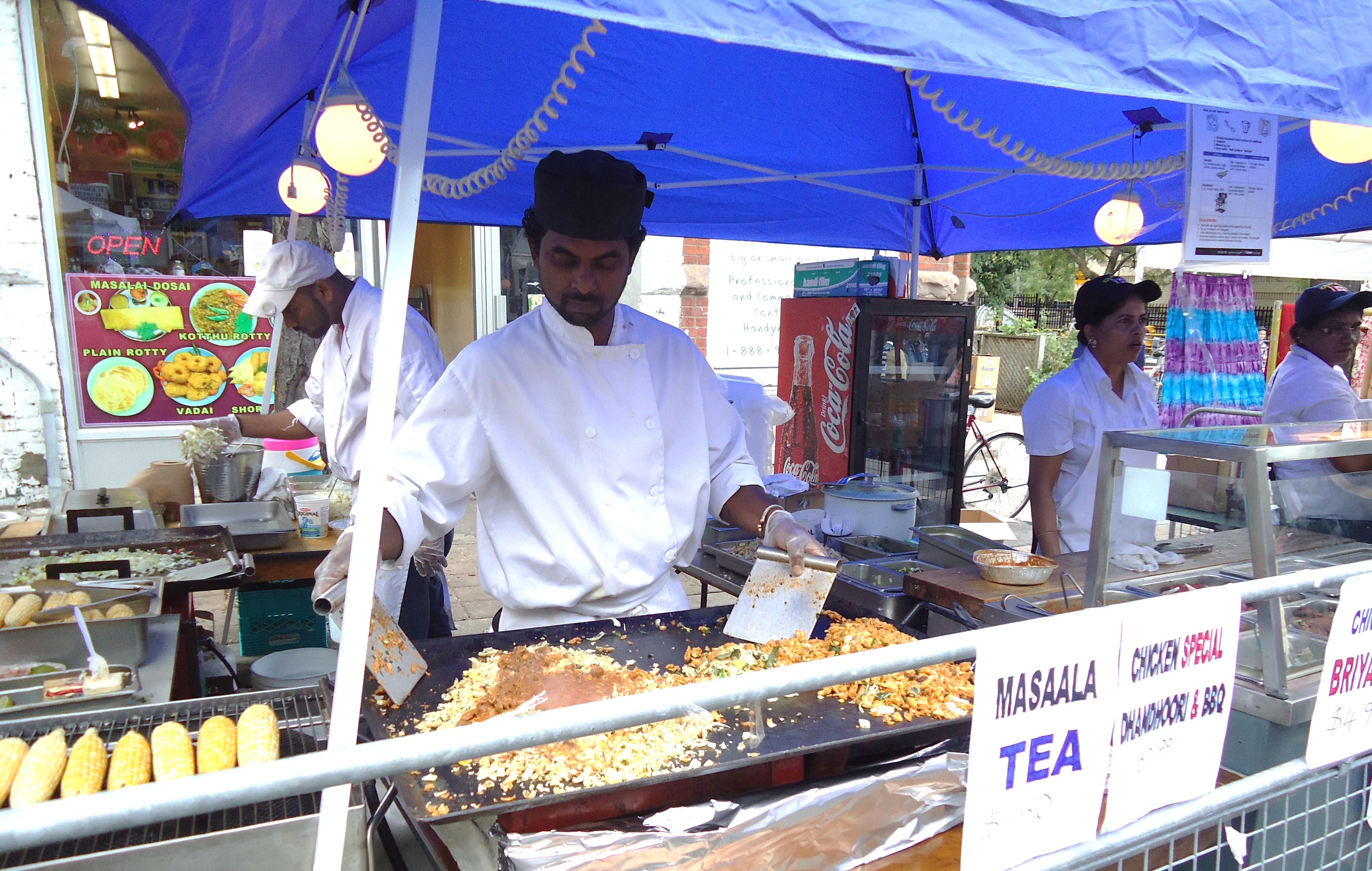

Kottu Roti (commonly known as Kottu) is one of the meals I enjoy the most from Sri Lanka. When I was a kid in Sri Lanka, it was a forbidden pleasure. Kottu then was well within social boundaries. As I remember, it used to be a cheap, takeaway meal for the lower classes. I remember my parents mention doggy hygiene of Kottu Roti establishments as the reason for not patronizing them (it is all about framing). During my recent visits to Sri Lanka I realized that it has become almost a staple diet. Kottu has finally managed to transcend social boundaries. It is not uncommon now for many well-to-do club crawlers in Colombo to end their night outs with a Kottu as a mid-night snack. But, most Kottu establishments in Sri Lanka (generally small road-side restaurants) still look grungy and often dirty, in my opinion.

Kottu is consisted of wheat flatbread very similar to Indian Paratha, vegetables (e.g., cabbage, carrots, and onions), eggs and/or meat (usually beef or chicken, but meat is optional), and spicy curry sauce. Traditionally, it is made on a purpose-made metal griddle, and the cutting up and mixing of ingredients is done using two blunt metal blades. It can be found in almost all parts of Sri Lanka, and is generally eaten as a dinner meal. It is not something that people have regularly, but it’s not something they have only once a year either.

My Cabbagetown version was intensely gratifying and I chowed it down with my Chai Latte from Starbucks. I was intrigued with the tastes of Sri Lanka. The texture was perfect (neither soggy nor dry) and had the right note of spices. My only complaint was that it had little chicken, but it was accompanied with enough vegetables.


My next gastro prey was Murtabak from Malaysia, a dish of grilled savoury roti stuffed with chicken, garlic, and onion. The filling is dollopped on to a very thin roti, which is then folded to form a large, square package. I have been to Malaysia many times but I never had Murtabak there. So, naturally I was curious about this dish. Apparently Murtabak originated in Yemen and Hija region of Saudi Arabia. The word murtabak is derived from mutabbaq which in Arabic means folded. Through traders it has spread first to India and then to Southeast of Asia. My Murtabak was beautifully browned and crispy, was quartered and served with homemade coconut chutney and chili-garlic sauce. It had a good amount of well-seasoned stuffing as well.


Although the weather wasn’t ideal, all in all, the 2012 Cabbagetown Festival was a successful gastronomic adventure. I think festivals like this are a clear celebration of street food, and an indication of how badly Torontonians need a diverse street food scene. It was a clear snapshot of what our street food scene in Toronto could look like.

Until next time, happy street eating!

Copyright© 2012 . All My Nosh . All Rights Reserved

Is Cupcake Mania Over?

I hate to be the party pooper, but I just don’t get why cupcakes are still trendy. Unless you are totally out of the loop on food trends, cupcakes are popping up everywhere, from bakery shelves to wedding showers. The cupcake craze has spawned dozens of bakeries devoted entirely to them. There are cookbooks, blogs, a cupcake truck with over 14,000 followers on Twitter, and magazines specifically dedicated to cupcakes. Cupcakes got a lot of attention in “Sex and the City” when Sarah Jessica Parker bit into a pink-frosted cupcake outside Magnolia Bakery on Bleecker Street in New York City. Also, remember the cupcake-inspired “Lazy Sunday” rap video, which was No.1 for some time on YouTube?

Before I give my two cents about cupcakes, here is a bit of cupcake history. Apparently, the cupcake evolved in the USA in the 19th century, and it was revolutionary because of the amount of time it saved in the kitchen. Food historians have yet to pinpoint exactly where the name of the cupcake originated. There are two theories: one, the cakes were originally cooked in cups; and, second, the ingredients used to make the cupcakes were measured out by the cup. Cupcakes were convenient because they cooked much quicker than larger cakes. Since their creation, cupcakes have become a pop culture trend in the culinary world.


Confectionary trends are changing very fast, and cupcakes are facing challenges from several fronts. For some reason, people went nuts for macarons in the past couple of years and everyone, from Toronto to Tokyo, seemed to be fascinated by these little sandwich cookies. I am not exactly sure why so many people are fascinated with macarons. You can find them at many neighborhood bakeries and pastry shops, and even in supermarkets. You can find macarons in a wide variety of flavors that range from the traditional (raspberry, chocolate, etc.) to off-beat (marmite, matcha, etc.).


Artisan donuts are also vying to share the spotlight with cupcakes. The James Beard Foundation named artisan donuts one of its 2012 trends to watch, and there are plenty of places to watch it. Most civilized cities (yes, that’s right) now boast at least one shop offering exotically flavored donuts at prices so far reserved for something more substantial – like a LV bag. At one Brooklyn eatery, the US$11 foie gras donuts sell out every night. Closer to home in Toronto, Paulette’s Original Doughnuts & Chicken offers exotic flavors – mojito, pretzel chocolate, raspberry balsamic, rose & berry, mocha, and garam masala – at a reasonable price.

Cupcakes also have become a victim of healthy living wars. As schools across the USA started enforcing federally mandated wellness policies, many schools have begun banning the little treats. Those cupcake addicted parents are fighting back though. Luckily for cupcake aficionados in Canada, the ban-the cupcakes-movement hasn’t crossed the 42nd parallel yet.

I don’t think the death of cupcakes is imminent. But I think cupcakes are no longer in vogue. People still like cupcakes for many reasons: easy to transport in those nifty cupcake boxes; can get a higher frosting ratio than a regular slice of cake; can get your very own decorations; and, can eat them with your hands. You have to consider the nostalgia aspect as well. Especially among those over-indulged baby boomers whose childhoods are littered with cupcake liners and sprinkles forever embedded in the wall-to-wall broadloom carpets of their living rooms.

But I wish if someone could convince me that the cupcake fad will pass, ideally soon. Just imagine — people might have to eat a real dessert! What a concept, no?

Copyright© 2012 . All My Nosh . All Rights Reserved

Chocolate by Trish Deseine

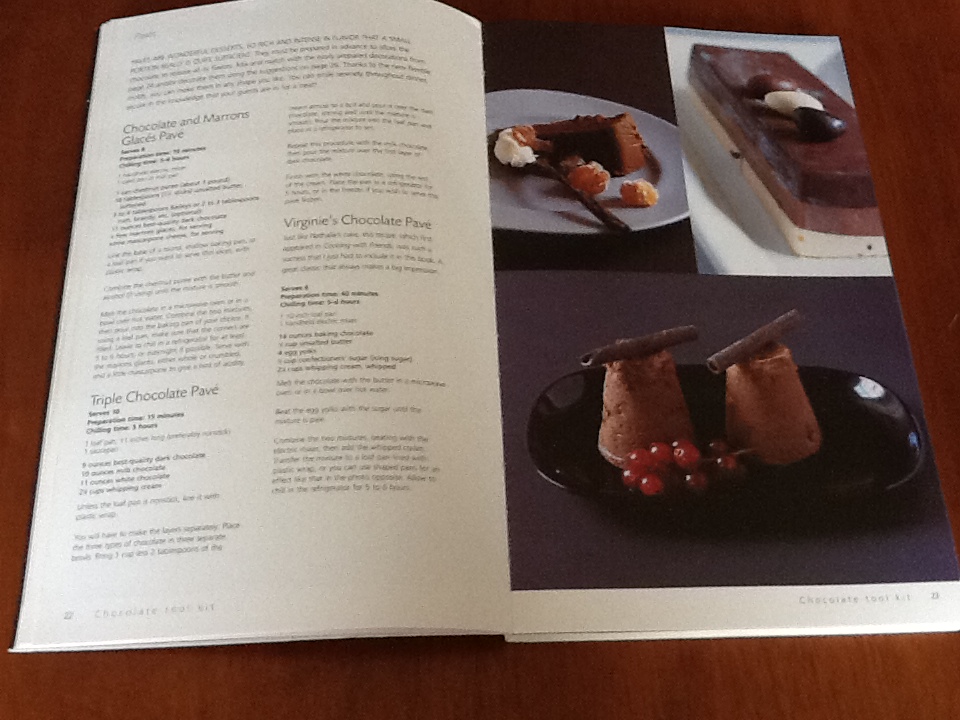
I love chocolate. I am not going to lie – I am a chocovore! I always wonder what the world would look like without chocolate. I also have a fetish for cook books, not just to try new recipes but also to read and to learn as much as I can about food. Recently, I have delved into many forms of chocolate and chocolate-based desserts. So I’ve really given a lot of thought on how to make sweet creations with chocolate. I came across Chocolate by Trish Deseine sometime ago and have so far tried several recipes from her book.


When I opened the book I was tempted beyond my ability to say ‘no’ to many recipes. The first recipe to try was The Best Brownies (p. 10). In my opinion, everyone should have a good chocolate brownie recipe and it should be the richest, gooiest chocolate brownie, so you don’t have to eat too much of it (yeah, I know). And this recipe was just that – the richest, moistest, most decadent brownie you could ever imagine.


I also tried Natalie’s Melt-in-Your-Mouth Chocolate Cake (p. 14). The decadent, almost flourless, chocolate cake was timeless, elegant and made you feel so good. It was even more perfect with some good accompaniments found in p.12 to cut through the sweetness. Her recipe for Triple Chocolate Brownie Crunch (p. 94) is so fabulously divine. This is a dish you won’t just stop at one helping. I made one change to the recipe; I used added Khalua to the milk chocolate sauce.


So far recipes for Banoffee, Emmanuelle’s Chocolate Cookie Cake, Jean-Francois’s Stuck Cake and Butterfly Cupcakes have kept me busy. If none of those interest you then there are others that will inspire you to search for chocolate. I must admit that all my attempts so far at making Triple Chocolate Pavé (p. 22) resulted in failure – I was never able to get the consistency of the white chocolate layer right.


Trish Deseine provides 100 or so simple and very do-able recipes, each one accompanied by stunning photographs (more like chocolate porn). The recipes are categorized into practical groupings, such as Chocolate with Crunch, Chocolate for Kids, Chic Chocolate and Chocotherapy. For some, working with chocolate could be an intimidating task. So the book also includes a section on the tricks and techniques and the various tools used in professional kitchens to carve, mould, melt and form chocolate to suit every possible need.

Verdict: This book has become my favourite chocolate cook book because recipes in it are magnificent creations that make me and many of my friends very happy. The book lives up to Trish Deseine’s media hype but that fact does not undervalue its credibility. Chocolate by Trish Deseine was ranked 4th among the 50 best cook books by The Independent in 2008.

4.5 Stars out of 5.

Publisher: Whitecap Books Ltd. (January 1, 2010)

Copyright© 2012 . All My Nosh . All Rights Reserved

Ritter Sport Marzipan

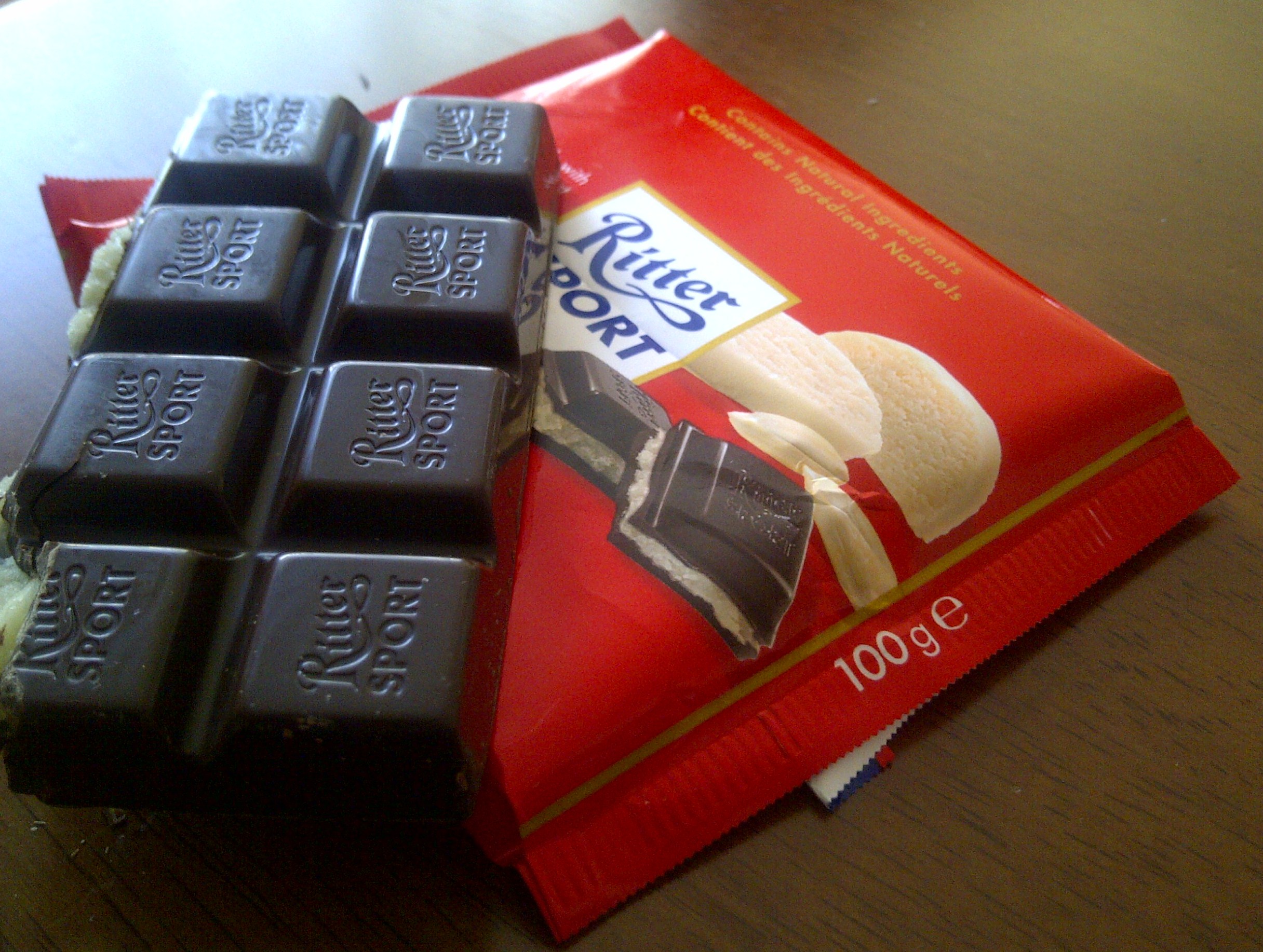
Recently, I tried to ration my chocolate consumption by buying smaller chocolate bars. So I grew curious about Ritter Sport bars. I mean curious in the same sense that junkies are curious about drugs. Each 100 gram square-shaped bar is divided into 16 smaller squares, creating a four-by-four pattern. With 190 calories per 6 squares, this is a great contender for my chocolate cravings.


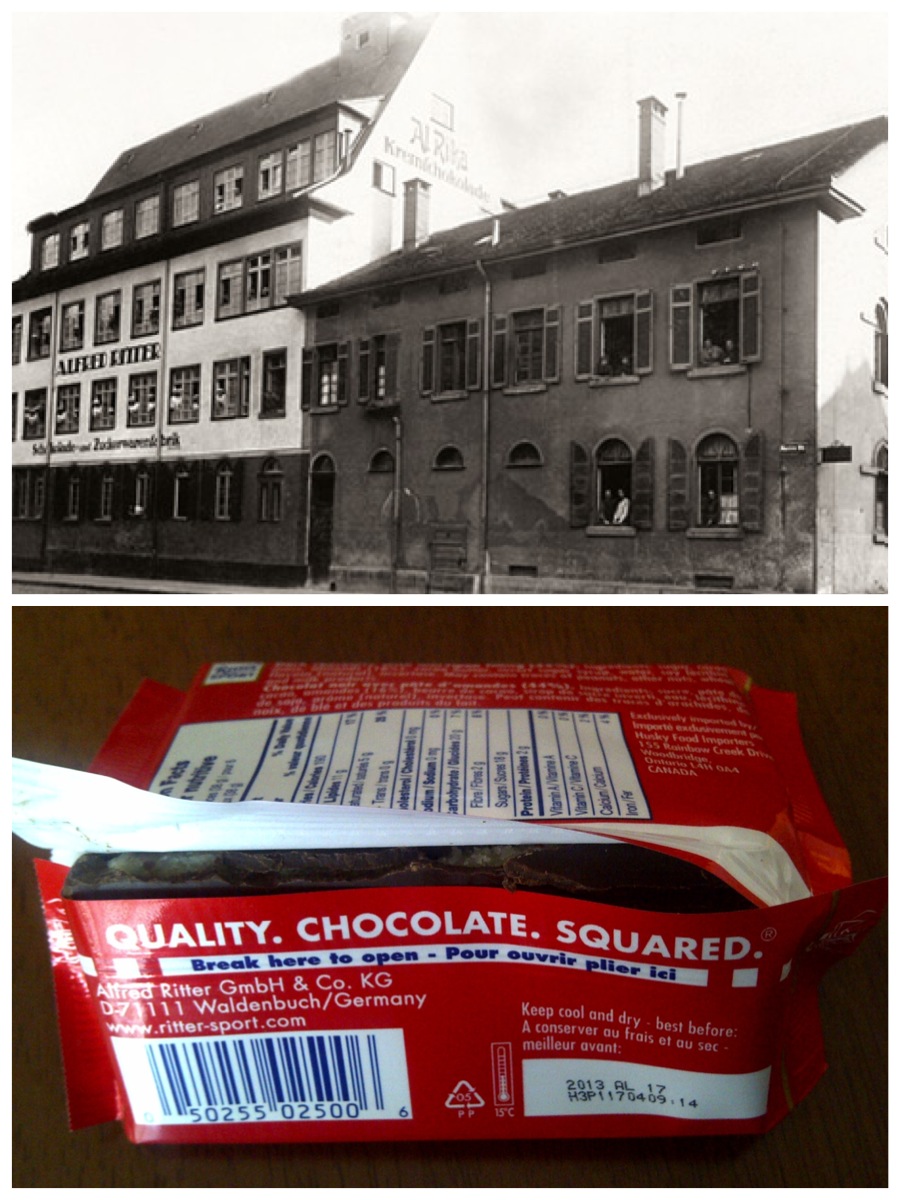
Ritter has a 100 year-old history of making chocolate bars. In 1912, Alfred Ritter and his wife, Clara Ritter, founded a chocolate factory in Inner Moltkestrasse in Bad Cannstatt, Germany. When production needs required a factory expansion, the company moved to Waldenbuch in 1930, a couple of miles outside Stuttgart. The chocolate brand Ritter’s Sport Schokolade produced as the square tablet known today was launched in 1932 after Frau Ritter suggested creating a chocolate bar that would fit into every sport jacket pocket without breaking. Ritter has also done some innovative stuff with their packaging. In 1976, Ritter Sport invented the pack with the snap – simply flip the bar over and then snap it in two along the dotted line.


I picked up a Ritter Sport Marzipan bar – dark chocolate with marzipan center. Dark chocolate and marzipan are two of my favourite sweet flavours and I couldn’t resist tasting this bar. Ritter’s dark chocolate is made from West African cocoa and cocoas from Papua New Guinea and Madagascar with 50% cocoa content. I really enjoyed the non-flakiness of dark chocolate and it had a subtle enough flavour that I enjoyed it a lot. Dark chocolate was bitter in a very pleasant way. The marzipan layer had the right thickness and was nicely moist. The marzipan flavour was great with right balance of sweetness without overpowering the dark chocolate notes. Altogether, there was a great balance of bitterness of chocolate and creamy texture of marzipan. Dark Chocolate with Marzipan is probably the most delicious thing that can happen to almonds.


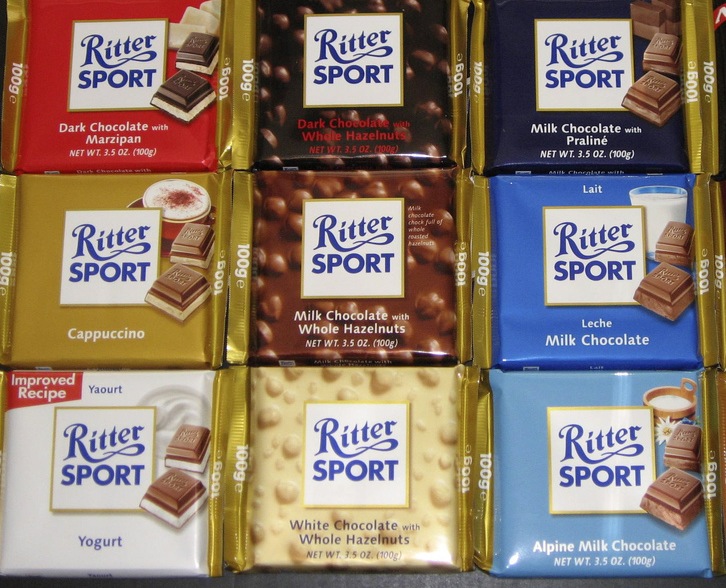
While I was munching on the Ritter Sport bar I was comparing it to the Niederegger chocolate covered marzipan loaf. I think the Ritter version is on par with Niederegger in terms of flavour profile, although the latter has a thicker marzipan center. My original plan was to savour only six squares (190 calories); but, it was pretty decadent and I didn’t feel it is fair to Mr and Mrs Ritter if I only eat six sections at a sitting. I would certainly buy Ritter Sport Marzipan bar again, but I would try other Ritter Sport flavours before making this my favourite Ritter. After all, not including seasonal and limited edition flavours, Ritter Sport has over 25 varieties. I have more to taste, indeed.

Note: The photo of first Ritter factory is from http://www.ritter-sport.us.

Copyright© 2012 . All My Nosh . All Rights Reserved
Welcome Cherry Season!

One must ask children and birds how cherries and strawberries taste.
Johann Wolfgang von Goethe

Cherries are now in season. You can find many varieties of cherries in supermarkets, farmers’ markets, and pick your own cherry farms. Did you know that cherries are part of the Rosaceae family, and has cousins including apricots, almonds, peaches and plums? Most common types of cherries you will find include Rainiers, Van, Skeena, Staccato and Bing cherries. Sweet cherries had spread to Ancient Greece and the Mediterranean by 300 BCE, for Theophrastus mentions them. And Pliny the Elder (1st century AD) mentions that some 8 varieties of cherries were being cultivated in Italy, and that the Romans were spreading them as far north as Britain. The British, in turn, carried it to the New World in the 17th century.


Today, it is estimated that some 900 sweet varieties (ranging in color from yellow to black) and some 300 sour varieties are being grown. Most sweet cherries will produce fruit only after they’ve been cross-pollinated. Honey bees usually do the leg work, carrying pollen from a sweet cherry of another variety. Sours are mostly self-fertile. Another factoid about cherries: once planted, a cherry orchard takes 4 to 6 years to reach full production.


My favourite type of cherry is Rainier Cherries; they are called the princess of cherries. It is a large sweet cherry with a red blush. Sometimes they are called white cherries because of the flesh color and their skin is yellowish red blush when they are ripe. I like them because they are firm, with a nice texture and sweet flavour. When I buy cherries, I look for cherries that are firm to touch, and are without bruising or soft spots. I like to pick cherries with the stems on because with stems it is easier to pop them in my mouth.


Some folks say that cherries have health benefits. Apparently cherries have anti-inflammatory properties. People of First Nations have used wild cherries to treat fever, inflammation and sore throats. In folk medicine, cherries and their juice are used to prevent gout. Whatever their health benefits are, their taste alone is good enough to finish a whole bowl in one sitting. Spitting the pits is whole another story.

Besides eating them au natural, you can turn cherries into many tasty noshes. My natural inclination is turn them into salads and desserts. Here are two of my favourite recipes.


Bing Cherry and Mixed Green Salad with Kirsch Vinaigrette

Ingredients for the vinaigrette:
¼ cup Kirsch
2 shallots, finely chopped
2 tablespoons white balsamic vinegar
2 teaspoons Dijon mustard
1/2 cup extra virgin olive oil
Salt and freshly ground pepper

Ingredients for the salad:
6 cups mixed greens (e.g., radicchio, escarole and arugula, Belgian endive)
1/4 pound blue cheese (e.g., Roquefort or Gorgonzola)
1 cup crostini croutons (I use Guy Fieri’s recipe, but you can use your own)
1 cup fresh pitted Bing cherries, halved

Directions

  • In a bowl, whisk the vinegar with the mustard. Whisk in the Kirsch, then gradually whisk in the extra virgin olive oil. Season the vinaigrette with salt and pepper.
  • Add the greens to the vinaigrette and toss to coat. Add the blue cheese, croutons, and cherries. Toss to combine and serve. Serves 4-6.


Cherry Clafouti

Ingredients:
1 tablespoon softened butter
1 cup whole milk
1/4 cup heavy cream
2/3 cup all-purpose flour
3 large eggs
1/4 cup granulated sugar
2 teaspoon almond extract
1/4 teaspoon salt
4 cups dark pitted cherries, preferably Bing cherries
1 tablespoon confectioners’ sugar

Directions:

  • Preheat an oven to 350F. Butter a round 9-inch baking pan with some softened butter.
  • In a large bowl, whisk together the milk, cream, flour, eggs, sugar, almond extracts, and salt until it forms a smooth, thin batter. Spread 3/4 cup of the batter onto the bottom of the prepared baking pan and bake it for 2-4 minutes. Watch the batter closely and remove it before it cooks through completely. It should just start to thicken and set when it is removed from the oven.
  • Transfer the dish to a heatproof surface and arrange the cherries over the hot batter. Pour the remaining batter over the cherries and bake for 35-40 minutes, until a knife inserted in the center comes out clean.
  • Sprinkle the confectioners’ sugar over the finished clafouti and serve it warm. This cherry clafouti recipe makes 8 servings.


Finally, here are some helpful cherry handling tips:

  • Store cherries in the refrigerator to keep them cold. They will last for up to a week.
  • Cherries ripen quickly and should be used as soon as possible upon ripening.
  • Don’t wash cherries until you are ready to use them.
  • Remove mushy or rotten cherries from the bag to preserve the rest.
  • You can freeze most types of cherries by first rinsing and draining them thoroughly.

Copyright© 2012 . All My Nosh . All Rights Reserved